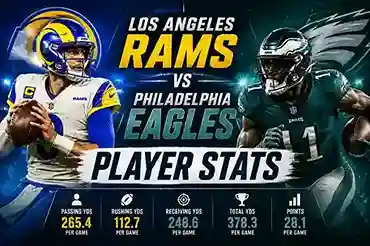
Los Angeles Rams vs Philadelphia Eagles Player Stats: Jalen Hurts and the Eagles Defense Steal a Wild Comeback Win
Nineteen unanswered points don’t usually disappear in an NFL fourth quarter, but the Los Angeles Rams vs Philadelphia Eagles player stats from this Week 3 shootout tell exactly that story. A dominant first half turned into a nightmare finish, and the box score explains every twist. Here’s the full statistical breakdown of how Philadelphia flipped a 19-point deficit into a 33-26 win.
The Lead
The Los Angeles Rams traveled to Lincoln Financial Field in Philadelphia on Sunday, September 21, 2025, for a Week 3 NFC clash in front of 69,879 fans. Sean McVay’s Rams came out firing, building a 19-7 lead by halftime behind four field goals from Joshua Karty and a deep touchdown strike from Matthew Stafford to Davante Adams. Philadelphia, unbeaten at 2-0 entering the day, looked shaky for two quarters against a Rams offense that mixed explosive plays with disciplined red-zone execution. The final score read Philadelphia 33, Los Angeles 26, and the Eagles improved to 3-0 while the Rams dropped to 2-1.
What changed the outcome wasn’t a single big play — it was a full third-quarter and fourth-quarter surge from Jalen Hurts, who threw for 226 yards and three touchdowns, combined with a fumble recovery and a game-sealing blocked field goal returned for a touchdown by defensive tackle Jordan Davis. The Rams vs Eagles player stats show Los Angeles actually out-gained Philadelphia in total yardage and first downs, which makes the collapse even more instructive for anyone studying how red-zone defense and special teams can override raw offensive production.
Match Overview Table
| Information | Match Details |
|---|---|
| Event | NFL Regular Season, Week 3 |
| Game | Los Angeles Rams vs Philadelphia Eagles |
| Date | September 21, 2025 |
| Venue | Lincoln Financial Field, Philadelphia, PA |
| Attendance | 69,879 |
| Winner | Philadelphia Eagles |
| Final Score | Eagles 33, Rams 26 |
| Broadcast | FOX |
Core Match Statistics Overview
The team stat sheet is where the los angeles rams vs philadelphia eagles match player stats get genuinely interesting, because the yardage battle didn’t match the scoreboard.
| Team Metric | Los Angeles Rams | Philadelphia Eagles |
|---|---|---|
| Total Yards | 356 | 288 |
| Turnovers | 1 | 1 |
| First Downs | 22 | 19 |
| Penalties | 4-41 | 5-50 |
| Third-Down Conversions | 3/10 | 5/14 |
| Fourth-Down Conversions | 0/1 | 4/5 |
| Red-Zone Efficiency | 1/4 | 3/3 |
| Time of Possession | 29:25 | 30:35 |
Red-Zone Execution
- The Rams settled for four field goals on four red-zone trips instead of touchdowns, capping their scoring ceiling despite 356 total yards.
- Philadelphia converted three of three red-zone chances into touchdowns, turning fewer possessions into more points — the single biggest swing in this Rams vs Eagles player stats comparison.
Fourth-Down Aggression
- Nick Sirianni’s staff went for it on fourth down five times and converted four, a decision-making edge that kept scoring drives alive when the Rams defense had stops within reach.
- Los Angeles attempted only one fourth-down conversion all game and missed it, reflecting a far more conservative approach that cost them extra possessions late.
Third-Down Efficiency
- The Eagles’ offense moved the chains on 5 of 14 third-down attempts (35.7%), a modest number that still outpaced a Rams offense converting just 3 of 10 (30%).
- Both offenses struggled on third down for stretches, which explains why time of possession stayed close at roughly 29-30 minutes per side.
Penalties and Discipline
- Philadelphia was flagged five times for 50 yards, slightly more than the Rams’ four penalties for 41 yards, but neither team let discipline decide the outcome.
- Rather than penalty yardage, situational football—red zone and fourth down—was the true differentiator.
Period-by-Period Analysis
| Quarter | Rams | Eagles |
|---|---|---|
| 1st | 10 | 7 |
| 2nd | 9 | 0 |
| 3rd | 7 | 14 |
| 4th | 0 | 12 |
| Final | 26 | 33 |
- First quarter: Jalen Hurts opened the scoring with a 1-yard rushing touchdown, but Los Angeles answered immediately — a Joshua Karty 51-yard field goal followed by a 44-yard touchdown strike from Matthew Stafford to Davante Adams gave the Rams a 10-7 edge.
- Second quarter: Karty was perfect from the leg, drilling field goals of 28, 33, and 46 yards to push the lead to 19-7 at the half while the Eagles offense went scoreless for the entire period.
- Third quarter: Kyren Williams caught a 10-yard touchdown pass from Stafford to make it 26-7, but Philadelphia’s offense finally clicked, with Dallas Goedert and A.J. Brown both scoring touchdowns off Hurts throws to cut the deficit to 26-21 entering the fourth.
- Fourth quarter: DeVonta Smith’s 4-yard touchdown catch (two-point conversion failed) put Philadelphia ahead 27-26, and Jordan Davis sealed it by blocking a Karty field-goal attempt on the final play and returning it 61 yards for the game-winning score.
Los Angeles Rams Player Statistics
Matthew Stafford (QB)
| Stat | Total |
|---|---|
| Completions/Attempts | 19/33 |
| Passing Yards | 196 |
| Touchdowns | 2 |
| Interceptions | 1 |
| Passer Rating | 82.4 |
Stafford’s arm produced two scoring drives, but a costly interception and a sack (which cost 0 yards) blunted his efficiency in a game the Rams led for three quarters. His 44-yard connection with Davante Adams was the single biggest explosive play of the first half.
Puka Nacua (WR)
| Stat | Total |
|---|---|
| Targets | 15 |
| Receptions | 11 |
| Receiving Yards | 112 |
| Long | 20 |
Nacua was the clear focal point of the passing attack, hauling in 11 catches on a team-high 15 targets for over 100 yards. He didn’t find the end zone, but his volume kept the Rams’ offense on schedule throughout the afternoon.
Kyren Williams (RB)
| Stat | Total |
|---|---|
| Rush Attempts | 20 |
| Rush Yards | 94 |
| Receptions | 2 |
| Receiving TD | 1 |
Williams handled a heavy 20-carry workload for 94 yards on the ground and added a 10-yard touchdown reception, giving Los Angeles Rams player performance real balance between run and pass through three quarters.
Davante Adams (WR)
| Stat | Total |
|---|---|
| Targets | 8 |
| Receptions | 3 |
| Receiving Yards | 56 |
| Receiving TD | 1 |
Adams turned modest volume into maximum impact, with his lone touchdown coming on a 44-yard deep shot that set the tone in the first quarter.
Philadelphia Eagles Player Statistics
Jalen Hurts (QB)
| Stat | Total |
|---|---|
| Completions/Attempts | 21/32 |
| Passing Yards | 226 |
| Touchdowns | 3 |
| Interceptions | 0 |
| Rush Yards/TD | 40 yards, 1 TD |
| Passer Rating | 117.4 |
Hurts was the engine of the comeback, throwing three touchdowns without an interception and adding a rushing score, while overcoming four sacks to close the game with a 117.4 rating. His second-half production is the headline number in these philadelphia eagles player stats.
A.J. Brown (WR)
| Stat | Total |
|---|---|
| Targets | 10 |
| Receptions | 6 |
| Receiving Yards | 109 |
| Receiving TD | 1 |
Brown led all Eagles receivers with 109 yards and a touchdown, providing the vertical threat that stretched a Rams defense that had controlled the game for two and a half quarters.
DeVonta Smith (WR)
| Stat | Total |
|---|---|
| Targets | 9 |
| Receptions | 8 |
| Receiving Yards | 60 |
| Receiving TD | 1 |
Smith was Hurts’ most reliable target, converting 8 of 9 targets, and his fourth-quarter touchdown catch put Philadelphia ahead for the first time since the opening possession.
Saquon Barkley (RB)
| Stat | Total |
|---|---|
| Rush Attempts | 18 |
| Rush Yards | 46 |
| Receptions | 4 |
| Receiving Yards | 9 |
Barkley only managed 46 yards on 18 runs, far below his season average, which is precisely why the Eagles relied so much on Hurts and the passing game to complete the comeback.
Statistical Leaders Summary Table
| Category | Los Angeles Rams | Philadelphia Eagles |
|---|---|---|
| Leading Passer | Matthew Stafford (196 yds, 2 TD) | Jalen Hurts (226 yds, 3 TD) |
| Leading Rusher | Kyren Williams (94 yds) | Saquon Barkley (46 yds) |
| Leading Receiver | Puka Nacua (112 yds, 11 rec) | A.J. Brown (109 yds, 1 TD) |
| Special Teams/Defensive Play | Joshua Karty (4/4 FG) | Jordan Davis (blocked FG, 61-yd TD return) |
Why Philadelphia Won
Red-Zone Discipline
| Metric | Rams | Eagles |
|---|---|---|
| Red-Zone Trips | 4 | 3 |
| Red-Zone Touchdowns | 0 | 3 |
| Red-Zone Conversion Rate | 25% | 100% |
Philadelphia scored a touchdown on every single red-zone possession, while the Rams settled for four Karty field goals. That single category accounts for the bulk of the final scoring gap despite Los Angeles gaining more total yards.
Fourth-Down Aggression Paid Off
Sirianni’s staff converted 4 of 5 fourth-down attempts, extending drives that a more conservative team would have ended with a punt. That aggression let Hurts and the receiving corps stay on the field and wear down a Rams defense that had looked sharp in the first half.
A Complete Second-Half Turnaround
Philadelphia scored 26 unanswered points across the third and fourth quarters, powered by three Hurts touchdown passes and the special-teams score from Jordan Davis. The Eagles offense that managed zero points in the second quarter suddenly looked unstoppable once adjustments were made at halftime.
Why Los Angeles Lost
Settling for Field Goals Instead of Touchdowns
Four trips inside the red zone produced four field goals and zero touchdowns. In a game this close, that single trend — kicking instead of finishing drives — was the difference between a comfortable win and a heartbreaking loss.
The Fourth-Quarter Defensive Collapse
After holding Philadelphia to just 7 points through two and a half quarters, the Rams defense allowed 26 unanswered points, including a back-breaking blocked field goal returned for a touchdown on the final play of the game.
Historical Context & Advanced Insights
Recent Head-to-Head Meetings
| Date | Result | Note |
|---|---|---|
| January 19, 2025 | Eagles 28, Rams 22 | NFC Divisional Round; Saquon Barkley ran for 205 yards |
| September 21, 2025 | Eagles 33, Rams 26 | Week 3 regular season; four unanswered Eagles TDs |
Philadelphia has now beaten Los Angeles in back-to-back meetings, including a playoff win the previous January where Barkley bulldozed the Rams’ run defense for over 200 yards. This latest result extends a stretch where the Eagles have found late-game answers against a Rams team that plays fast, aggressive offensive football but has struggled to finish games against Philadelphia’s roster.
Efficiency Per Possession
Matthew Stafford completed 57.6% of his passes for 5.9 yards per attempt, a modest efficiency number weighed down by four field goals instead of touchdowns on scoring drives. Jalen Hurts, by contrast, posted a 65.6% completion rate at 7.1 yards per attempt and turned nearly every scoring possession into six points rather than three. That gap in points-per-drive, more than raw passing yardage, is the clearest advanced metric explaining the final outcome — Philadelphia needed fewer plays to finish drives once its passing game found rhythm in the second half.
Game Implications & Key Lessons
What This Means for Philadelphia
- The Eagles move to 3-0, and a comeback win of this magnitude builds real confidence heading into divisional and conference play.
- Jalen Hurts’ turnover-free, three-touchdown second half reinforces his standing as a fourth-quarter closer.
- The red-zone efficiency shown here (3/3) is a repeatable strength worth tracking across the rest of the season.
What This Means for Los Angeles
- The Rams must convert red-zone trips into touchdowns rather than field goals if they want to beat top-tier opponents.
- A fourth-quarter defensive letdown against Hurts and this receiving corps is a fixable but urgent problem heading into upcoming matchups.
- Special-teams execution, specifically field-goal protection, needs immediate attention after the game-deciding blocked kick.
Key Lessons
- Total yardage doesn’t guarantee wins — points-per-drive efficiency matters more.
- Settling for field goals in the red zone against a quality opponent is a losing formula over four quarters.
- Fourth-down aggression, when it works, can flip momentum and possession battles.
- A strong first half means nothing without sustained defensive execution in the fourth quarter.
- Special-teams plays, like a blocked field goal, can single-handedly decide close divisional-caliber matchups.
- Quarterback efficiency (completion percentage and yards per attempt) is often a better predictor of outcomes than total passing yardage.
Frequently Asked Questions
Who won the Rams vs Eagles game?
The Philadelphia Eagles won 33-26 over the Los Angeles Rams on September 21, 2025, completing a comeback from a 19-point second-half deficit.
Who had the best individual performance in the Rams vs Eagles player stats?
Jalen Hurts led all players with 226 passing yards, three passing touchdowns, and a rushing touchdown, while posting a 117.4 passer rating without an interception.
What were Matthew Stafford’s stats in this game?
Stafford completed 19 of 33 passes for 196 yards with 2 touchdowns and 1 interception, finishing with an 82.4 passer rating.
How many receiving yards did Puka Nacua have?
Nacua caught 11 of 15 targets for 112 yards, leading all Rams receivers in both catches and yardage.
What was the final score and where was the game played?
Philadelphia defeated Los Angeles 33-26 at Lincoln Financial Field in Philadelphia in front of 69,879 fans.
Did the Rams outgain the Eagles in total yards?
Yes. Los Angeles finished with 356 total yards compared to Philadelphia’s 288, but the Eagles’ superior red-zone and fourth-down conversion rates decided the final score.
Conclusion
The full Los Angeles Rams vs Philadelphia Eagles player stats confirm what the scoreboard alone can’t show: this game was won in the red zone and on fourth down, not in the open field. Philadelphia turned three red-zone trips into three touchdowns while Los Angeles settled for four field goals, and that efficiency gap — paired with a game-sealing blocked kick — outweighed the Rams’ advantage in total yardage. Teamwork, situational execution, and finishing drives carried the Eagles to a 3-0 start, while the Rams leave Philadelphia with a hard lesson about converting opportunities into points.